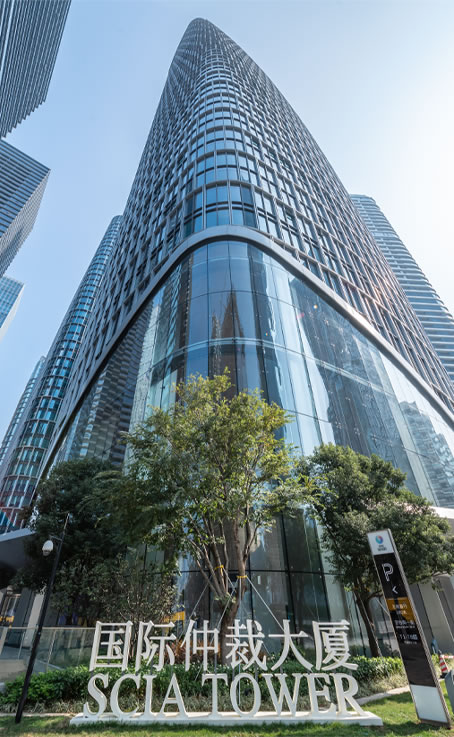
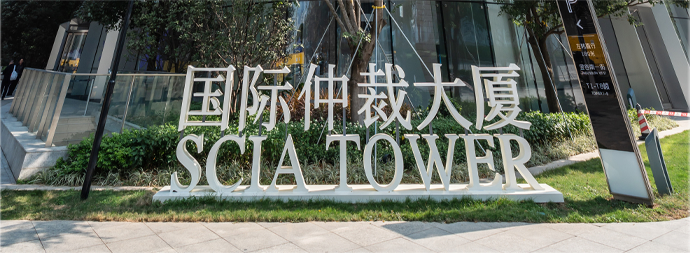
Liu Xiaochun, president of the Shenzhen Court of International Arbitration and executive chairman of the South China International Arbitration Center (HK), delivers welcome remarks at an inauguration ceremony for upgraded international arbitration facilities during Hong Kong Arbitration Week events on Oct 21. [Photo provided to chinadaily.com.cn]
The Shenzhen Court of International Arbitration (SCIA) and the South China International Arbitration Center (HK), or SCIAHK, held events for Hong Kong Arbitration Week on Oct 21, including the inauguration of upgraded arbitration facilities.
Under the theme "New Spaces, New Horizons, New Frontiers", the events drew nearly 100 legal and business representatives and international legal professionals from the Chinese mainland, Hong Kong, Macao, and Portuguese-speaking countries.
Discussions focused on strengthening Shenzhen-Hong Kong cooperation in international legal and dispute resolution services and expanding cross-border arbitration cooperation between China and Portuguese-speaking countries.
Founded in 1983, SCIA was the first arbitration institution in the Guangdong-Hong Kong-Macao region and handles contractual and other disputes over property rights and interests involving domestic and overseas parties.
SCIAHK, established by SCIA in 2019 as an independent institution under Hong Kong law, operates with its Shenzhen counterpart under the "Two Cities, Two Institutions" framework to strengthen arbitration, mediation, and other dispute resolution services in Hong Kong and beyond.
Liu Xiaochun, president of SCIA and executive chairman of SCIAHK, said the new space with upgraded hearing rooms is a physical commitment to Hong Kong as a leading seat of international arbitration.
He described it as "a bridge between civil-law jurisdictions and common-law jurisdictions", linking the Greater Bay Area and overseas legal communities.
"Today is not simply about a larger office. It is about greater capacity, stronger connectivity and confidence in the future of international dispute resolution," said Roden Tong Man-lung, president of the Law Society of Hong Kong, adding that business fundamentally relies on trusted institutions.
Cheung Kwok-kwan, deputy secretary for justice of Hong Kong, said upgrading the hearing facilities would help the two institutions meet the sophisticated demands of the Greater Bay Area and international users seeking efficient, reliable, and world-class arbitration services.
He cited a landmark October 2025 ruling by the Shenzhen Intermediate People's Court that recognized and enforced an arbitral award administered by the Hong Kong institution.
The case fell under a policy expanded in February 2025 to all nine mainland cities of the Greater Bay Area, allowing eligible Hong Kong-invested enterprises to choose Hong Kong as their arbitration seat.
Echoing the importance of these developments, Liu Changchun, chairman of China Legal Service (Hong Kong), added that the "Two Cities, Two Institutions" strategy and the successful enforcement of such awards were milestones for rules integration within the Greater Bay Area.
On the legislative front, Cheung said work was under way on proposed amendments to the Hong Kong Arbitration Ordinance, with the aim of completing the process by next year to keep the city's arbitration regime abreast of international practice.
International organizations also commended the institutions' collaborative efforts.
"By joining hands, we can better serve the global partners and contribute significantly to the cause of peaceful dispute resolution," said Sun Jin, deputy secretary-general of the International Organization for Mediation.
Domitille Baizeau, co-chair of the Hong Kong International Arbitration Centre, recognized the timely facility upgrade and praised their joint commitment to promoting diversity within international arbitration.
Abdul Carimo Mahomed Issa, president of the Arbitration, Conciliation and Mediation Centre of Mozambique, said Mozambique followed a civil-law system but also interacted with neighboring common-law jurisdictions, making exchanges with Hong Kong particularly relevant.
Sofia Martins, chairwoman of the Portuguese Arbitration Association, said growing trade, investment, and infrastructure links between China and Portuguese-speaking countries were increasing the importance of cross-border dispute resolution.
"The need for trusted, sophisticated and internationally minded dispute resolution mechanisms will only become more important," she said, expressing hope for lasting cooperation with Chinese arbitration institutions.
Contact the writers at effiezhang@chinadailyapac.com